How to craft a knife in CS2 — a complete guide with top recipes
How to craft a knife in CS2 — a complete guide with top recipes
On October 23, 2025, Valve expanded the “Trade Up Contract” in Counter-Strike 2: now you can trade five red (Covert) skins and get a rare “gold” item — a knife or gloves. For a lot of players, this became the simplest way to get a knife without opening cases.
But it’s not a “make it pretty” button. Mistakes cost real money: some people mix collections and lose their shot at the knife they wanted, some get confused with StatTrak, and some buy in when prices are overheated and everything’s flying up.
In this guide, we’ll break down how knife crafting works, how not to throw your contract for no reason, which builds you’ll see most often, and how to judge the risk so you’re crafting with a plan — not just praying to RNG.
How does knife crafting work in CS2? The Trade Up Contract mechanic
A “Trade Up Contract” is an in-game system where you give up several skins and get one item that’s higher rarity. After the 2025 update, there’s a separate branch for knives and gloves: you hand in 5 Covert skins (red-tier), and you get 1 “gold” item.
Important: this didn’t replace the classic 10-item Trade Up. It’s just a separate format — “5 reds → gold.” One more thing about StatTrak: if you want a StatTrak knife, all 5 items in the contract must be StatTrak. You can’t mix StatTrak and normal items — you’ll get a normal result.
Why did the market get shaken up? Because demand for red skins jumped hard (they became “consumables” for knives), and there are more knives and gloves on the market now — so some older prices really dropped, while some red skins got more expensive.
Step-by-step: how to craft a knife in 5 steps
Below is the basic flow. It’s the same for any knife — the only difference is which collections you take your red skins from.
Step 1: Open your Inventory and find the “Trade Up Contract”
Go to Inventory → scroll to the tools section → open “Trade Up Contract.” The game will show the contract window where you add skins.
Step 2: Pick 5 Covert skins (red-tier only)
Only Covert items work for knife/glove contracts. Exactly five. If even one item is a different rarity, the game won’t let you confirm the contract.
Step 3: Check the collection list (this is the key step)
Before you confirm, the game shows which collections your skins are from. That’s your “chance map”: the more collections you mix, the bigger the knife/glove pool you can roll.
Step 4: Confirm the contract
Click “Complete Trade Up.” The game will ask you to confirm again — that’s normal. This is irreversible, and your skins will be removed from your inventory.
Step 5: Get your knife
You’ll see a short animation, and the item will instantly show up in your inventory. If you plan to sell it, don’t forget marketplace fees and Steam Wallet limits.
Critical rule: don’t mix collections
The most common reason for “why didn’t I get what I wanted” is mixing collections by accident. The contract works on a simple rule: your result odds depend on how many items from each collection you put in.
Here’s what that looks like in practice:
5 skins from one collection → your result will be from that same collection only.
4 skins from A + 1 from B → about an 80% chance for a result from A, and 20% from B.
3 from A + 1 from B + 1 from C → about 60% for A, and 20% each for B and C.
The game shows the collection list before you confirm. Spend 10 seconds and check it — it’s way cheaper than buying another 5 reds later.
Drop odds: the math that actually works
Think of a collection as a set of possible “gold” items. The wider the set, the lower your chance for the exact knife you want. So a good craft is always a balance: either you pay for control (5 from one collection), or you save money but take more risk.
Below is a simple table to quickly estimate odds based on your collection split:
Skin combo
Result odds
5 skins from Collection A
100% — result from Collection A
4 skins A + 1 from B
80% A, 20% B
3 skins A + 2 from B
60% A, 40% B
3 skins A + 1 from B + 1 from C
60% A, 20% B, 20% C
2 from A + 2 from B + 1 from C
40% A, 40% B, 20% C
If you care about one specific knife, it’s almost always better to stick to one collection. If your goal is just “get a gold item cheaper,” you can mix — but you have to accept that the result gets way more random.
Top knife crafting recipes: which skins do you need?
A “recipe” in crafting is basically the choice of collection(s) and a set of 5 red skins. Below are some of the most popular directions — plus what to watch for so you don’t accidentally buy the wrong rarity tier.
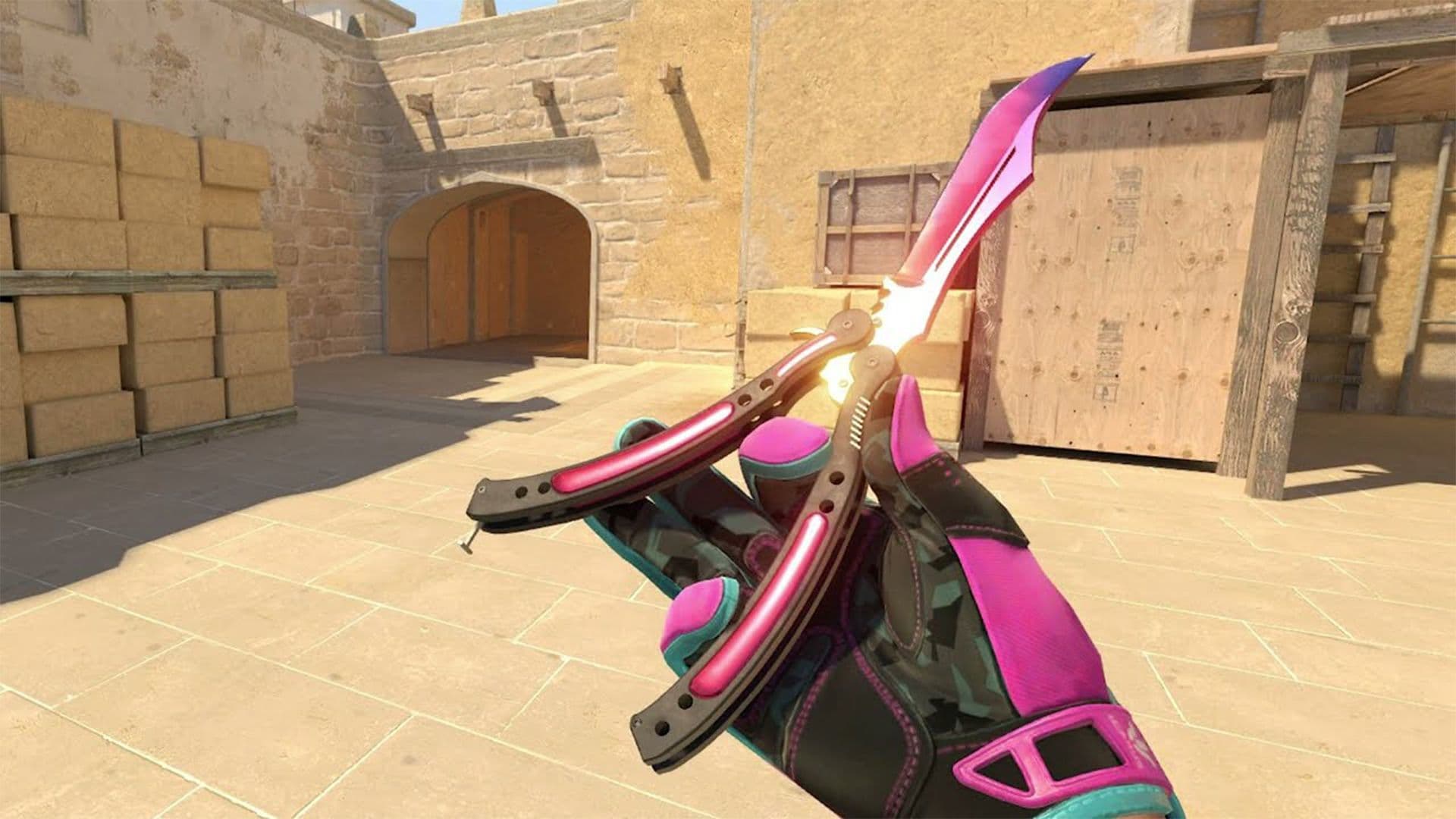
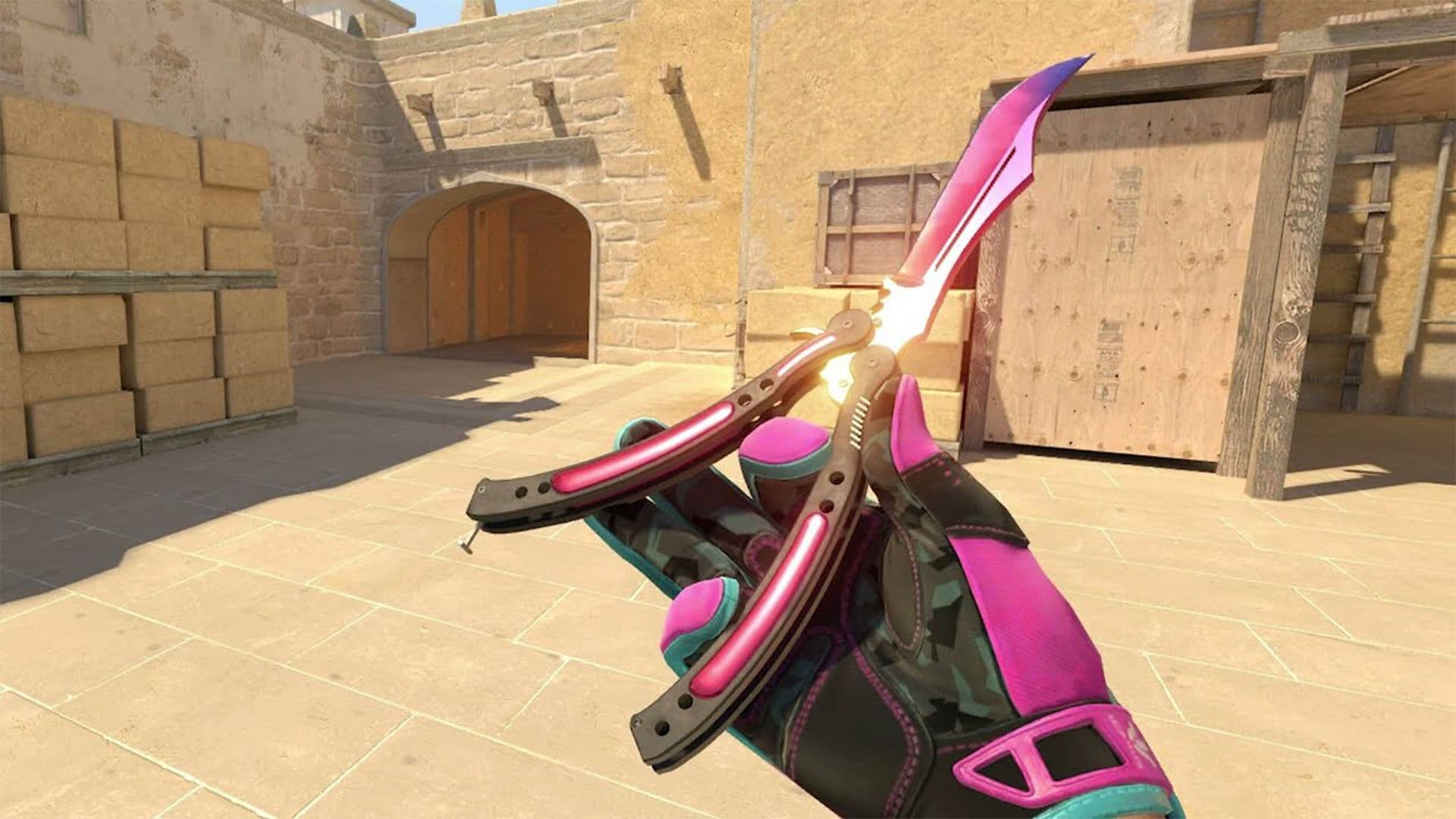
Butterfly Knife: the king of knives
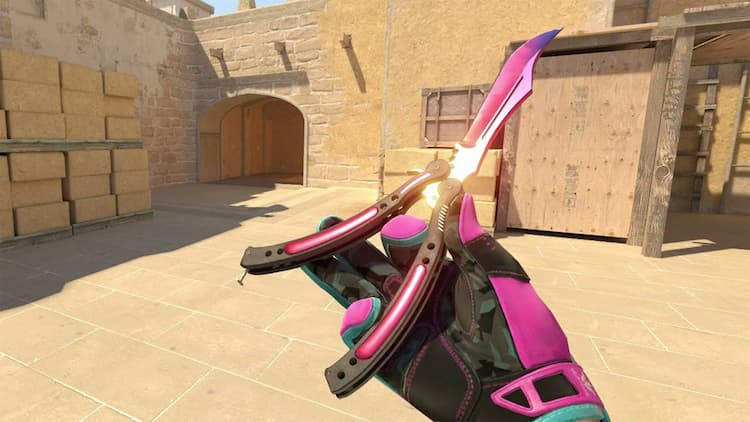
People love the Butterfly for the animations and the fact it usually holds value. The easiest way to boost your Butterfly odds is to pick a case/collection where it takes up as much space as possible in the “gold” pool.
100% guaranteed method: the “Breakout” collection
In the Operation Breakout Weapon Case (“Breakout”), the rare items are only the Butterfly Knife (Butterfly Knife) in different finishes. So if you do a contract from this collection, the knife model will be a Butterfly every time (the skin/finish is still random).
To build the contract, you need 5 Covert skins from Breakout. In practice, there are only two:
P90 Asiimov (Covert, Breakout)
M4A1-S Cyrex (Covert, Breakout)
Most players either buy five of the same one (cheaper and easier to track), or mix these two — but they always stay inside the same collection.
If you want a cheaper entry, you can mix collections where the Butterfly exists in the rare pool, and pad the contract with cheaper reds from other cases. But here’s the catch: the more cases you combine, the wider the pool — and your Butterfly odds drop.
To avoid buying blind, do this: first open the case page and confirm the “special items” really include the Butterfly Knife, then check which exact red skins belong to that case, and only then build a 4+1 or 3+2 contract.
Simple example for Spectrum Case: the Covert skins there are AK-47 | Bloodsport and USP-S | Neo-Noir. If you use 5 reds from Spectrum, your result will be a “gold” item from the Spectrum pool, where the Butterfly can appear among the knives.
Karambit: the second most popular knife
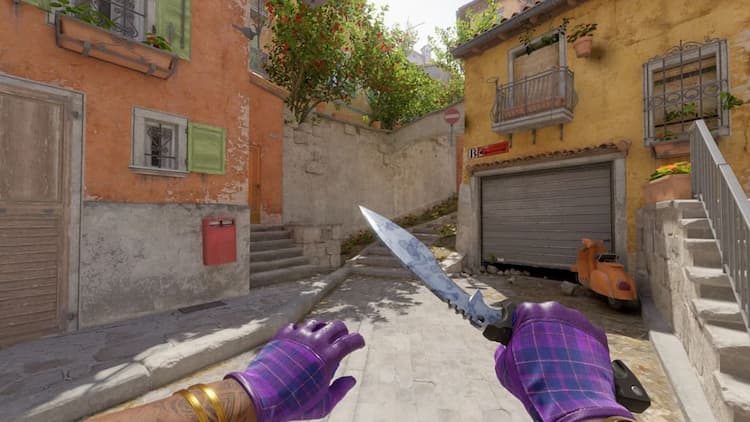
Players love the Karambit for the animations and the blade shape. The key thing: a “guaranteed Karambit” is rare, because it almost always shares the pool with other knives from the same case.
Below is the general logic by cases/collections. The numbers are a rough guide, because the pool depends on the specific case and its special item set:
Collection
Craft cost
Karambit odds
Knife market price
Case/collection where special items are only Karambits (almost never happens)
$500–700+
close to 100%
$800–2,000+
Gamma / Chroma and similar cases (Karambit is in the pool)
$300–500
usually not very high
$1,500–3,000
Mixed contract from 2 collections
$300–600
depends on 4+1 / 3+2 split
depends a lot on the finish
If you’re chasing Doppler (and especially Ruby/Sapphire), treat it like a lottery: your chance at a specific phase is tiny, and the entry is expensive. For beginners, it’s usually smarter to grab a more stable knife first, then come back to the “color” phases later.
How to craft a Talon Knife: mechanics and requirements
The Talon Knife is part of the knife set that showed up in the Horizon Case. The crafting mechanic is the same as everywhere: pick a collection, get 5 reds, confirm the contract.
Step-by-step looks like this:
Decide which case/collection you want to craft from (for example, Horizon Case).
Buy 5 Covert skins from that same collection.
Check that all 5 items are from one collection and one type (all normal or all StatTrak).
Confirm the contract and get one random “gold” item from that collection’s pool.
The main idea is simple: the narrower the pool in your chosen collection, the higher your chance to hit the knife model you want.
Which skins do you need to craft a Talon Knife? Choosing the collection
Success here comes down to the collection. In Horizon Case, the special items include Talon Knife, Stiletto, Ursus Knife, and Navaja. Plus, gloves can sometimes be in the pool too — it depends on how Valve tied “gold” drops to that specific container.
The rule doesn’t change: you need 5 of the cheapest Covert skins from that collection. After that, it’s on you whether you’re OK with the risk of pulling a different knife from the pool instead of a Talon.
Recipe and profit check
A truly “guaranteed recipe” almost always means choosing a collection with a narrow pool. If the pool is wide, all you can do is run the math and decide if the risk is acceptable.
A solid workflow is:
Pick the collection (case) you want the “gold” item from.
Find the 5 cheapest Covert skins from that collection and add up the cost.
Open a contract calculator and look at the full list of possible results and their prices.
Compare your entry cost to the cheapest possible result and the average price across all outcomes. If your entry is almost the same as the “minimum,” the risk is high.
This way you at least know what you can lose in the worst case — and you’re not slamming the button on pure эмоtion.
How to craft a Nomad Knife: from picking a collection to the contract
The Nomad Knife is part of the Shattered Web Case knife set. This uses the “new craft” in the usual way: to roll a “gold” item from this case, you need 5 Covert skins from Shattered Web.
Here’s the step-by-step plan:
Find the Shattered Web case/collection and confirm Nomad Knife is in the special item pool.
Buy 5 Covert skins from Shattered Web (aim for the cheapest ones on the market).
Before you confirm, check that all 5 items are from Shattered Web and the same type (all normal or all StatTrak).
Check outcomes in a calculator and compare prices so you understand the risk.
In Shattered Web, the pool usually includes multiple knives at once (Nomad, Skeleton, Survival, Paracord) — so your odds for one specific model won’t be “locked.”
How to craft a Skeleton Knife: key differences and the right approach
The Skeleton Knife is a specific knife model from the Shattered Web set. A common mistake is that people call any knife with cutouts a “skeleton,” but for crafting, the model matters — not the look of the finish.
To avoid missing, do two things first:
Check which case/collection the Skeleton Knife is in (most often Shattered Web).
See how many knives/gloves are in that collection’s pool — this directly affects your odds.
Skeleton Knife crafting strategy
Step-by-step strategy:
Goal and collection. Decide which model you want and which case you’re crafting from.
Market check. Find the 5 cheapest Covert skins from that collection.
Cost math. Add up the entry and estimate worst/average outcomes using a calculator.
Decision. If you’re not OK with the worst-case loss, don’t press the button.
Other popular knives: Gut, M9 Bayonet, Flip Knife
If your goal is just your first knife in your inventory, you don’t have to tunnel on Butterfly or Karambit. There are simpler models that are often cheaper and still look fine.
Below is a rough guide for “base” models. Prices and entry cost depend heavily on the case you pick and the condition (float):
Knife
Where to craft
Minimum craft cost
Market price
Gut Knife
Multiple collections
$50–150
$40–500
Flip Knife
Multiple collections
$100–200
$200–1,000
M9 Bayonet
Multiple collections
$200–400
$500–2,000
Falchion Knife
Multiple collections
$100–250
$300–1,500
These are just ballpark numbers. Before you buy, always check live prices — the market moves, and it can swing hard in a couple of days.
How much does it cost to craft a knife in CS2? Current prices for 2026
Prices for red skins and knives jump all the time — especially after patches, tournaments, and big sales. But to make it easier to navigate, here are typical ranges by budget and risk.
Price ranges by craft type
This isn’t a “price list.” It’s a quick guide so you know what kind of risk you’re signing up for:
Craft type
Cost
Risk
When to pick it
Cheap
$50–150
High (lots of outcomes)
Experiments, testing
Mid
$200–400
Medium (often 4+1 / 3+2)
Balance of cost/risk
Expensive, “controlled”
$500–1,000+
Low (narrow pool)
If you want control
The cheaper the entry, the more you’re buying pure randomness instead of control. And vice versa: when you pay more, you’re usually paying to narrow the outcome pool.
Profitability of different recipes
Here’s an example of how to read profitability. Important: “expected profit” is not a guarantee. It’s meant to show that odds + outcome prices matter more than one attractive target knife price.
Target knife
Craft cost
Success chance
Knife market price
Expected profit
Butterfly Vanilla
$150
About 20% (risky)
$70–100
−$50 to +$100
Butterfly Night
$200
About 30%
$400–600
+$200–400
Butterfly Doppler
$350
About 45%
$1,000–2,000
+$650–1,650
Butterfly Fade
$400
About 50%
$2,000–3,000
+$1,600–2,600
Karambit Doppler
$500
About 40%
$1,500–3,000
+$1,000–2,500
Karambit Ruby/Sapphire
$1,000+
<1%
$5,000–20,000+
Random
Read it like this: if your chance is 45%, then 45% of the time you hit the strong outcome, and the rest of the time you get a different item from the pool that can be much cheaper. That’s the risk.
Common beginner mistakes (and how to avoid them)
Crafting is easy button-wise, but brutal in the details. Here are four mistakes that burn budgets the most.
Mistake #1: Mixing collections out of greed
The usual story: “5 from one collection is expensive, but mixing is cheaper.” Result: the pool gets bigger, your odds for the knife you want go down, and you pull something you didn’t plan for.
How to avoid it: if your goal is a specific knife, stick to one collection. If your goal is just to test luck, mix — but accept the risk upfront.
Mistake #2: Breaking the StatTrak rule
A lot of people think you can put 4 StatTrak and 1 normal, and still get a StatTrak result. Nope: the contract must be 100% StatTrak, or the result will be normal.
How to avoid it: either all 5 items are StatTrak (if you want the counter), or all 5 are normal. Mixing almost always ends in disappointment.
Mistake #3: Buying skins at the price peak
After patches and hype, prices for the reds you need can spike in a single day. If you buy on эмоtion, there’s a good chance your entry will be cheaper a week or two later.
How to avoid it: watch the price for at least a couple of days, don’t buy “today at any cost.” Usually the market cools off and the entry becomes more reasonable.
Mistake #4: Bad ROI thinking
A beginner sees an expensive knife and assumes crafting is automatically profitable. But profit is math: entry price, list of possible outcomes, and the odds for each one.
How not to make mistakes
How to avoid it: before you craft, quickly estimate expected value (EV):
Make a list of possible results (knives/gloves).
Check current prices for each outcome.
Factor in the odds (or your collection split) to estimate the average result.
Compare the average result to your entry cost. If the average is lower, you’re losing in the long run.
Yeah, you can get lucky once — but over time, the players who do the math and don’t hit the button on эмоtion come out ahead.
How do you craft a knife in CS2, and what do you need for a contract?
Starting with the 23.10.2025 update, the Trade Up Contract works like this: you hand in 5 Covert (red) skins and you get a “gold” item — a knife or gloves.
Can you get a StatTrak knife through a contract?
Yes — but only if all 5 skins in the contract are StatTrak. If you mix in a regular one, the result won’t have a counter, and that’s a common reason people say “why is it not the right knife?”
How do you boost your chance for a Butterfly Knife, so you don’t ruin the contract?
The most reliable option for the model is 5 Covert skins from Breakout: the only special item there is the Butterfly Knife. The finish (colour) is still random, though.
How do you know if the craft is worth it, or if it’s just RNG?
Add up the price of the 5 reds, check every possible outcome (knives/gloves), and compare it to your buy-in. Also, don’t buy on hype right after patches: prices often drop back down.