Top Sites with the Best CS2 Cases
1.

HyperDrop
More
+30% deposit bonus
Promo
CSSPOT
2.

GGDrop
More
+11% & +1 Free Spin on bonus wheel
Promo
CSSPOT
3.

MYCSGO
More
+30% deposit bonus
Promo
CSSPOT
4.

Bounty Stars
More
Free Case 1$
Promo
fhy28756

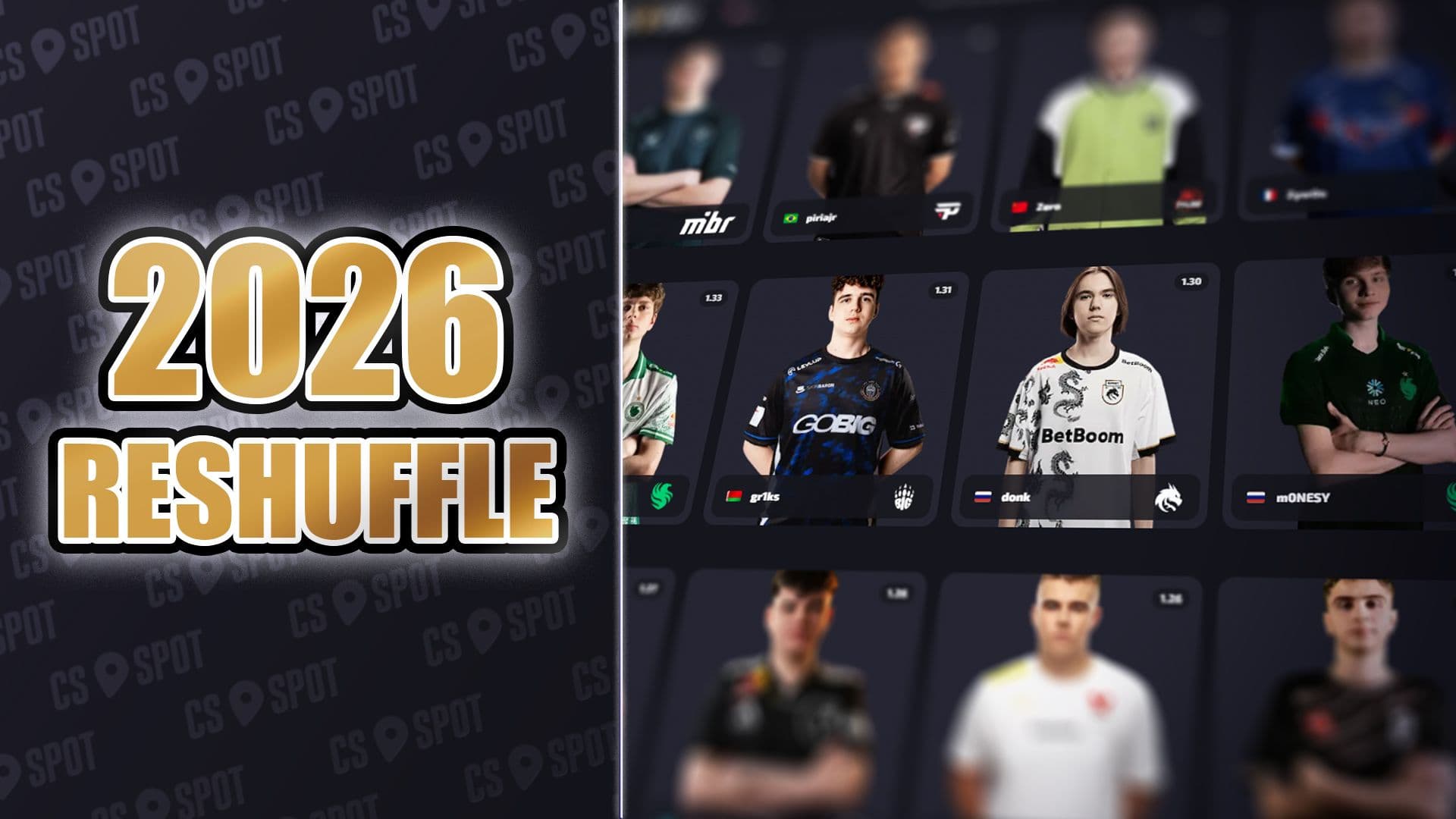
First things first: CS2’s early-2026 shuffle is less about “winning the offseason” and more about surviving the new invite economy. The moves below show how teams are chasing results, protecting VRS cores, and sometimes accepting short-term pain for long-term access. Stick around and follow the dominoes to see who set themselves up for the first big tests of 2026.
Teams are rebuilding now because Valve’s Regional Standings (VRS) changed what matters. It’s not only about fixing a bad LAN anymore. Invitations to many events are strongly tied to ranking math, so steady results matter more, and frequent roster swaps can hurt a team’s position over time.
Here’s the simple way to think about it:
For CS2 players, this is why some moves look careful and others look drastic. Teams are trying to improve without losing the ranking stability that keeps their season on track.
100 Thieves finished their new CS2 roster by signing Nicolai “device” Reedtz, after already adding Alex “poiii” Nyholm Sundgren, André “Ag1l” Gil, and William “sirah” Kjærsgaard.
They also listed Lukas “gla1ve” Rossander as head coach and kept Håvard “rain” Nygaard as the other veteran piece.
The key detail is the plan: this group is expected to start from zero and grind their way to a VRS ranking through open LANs and lower-tier tournaments, instead of buying a ready-made VRS core.
This “from scratch” route usually means tighter schedules, more must-win matches, and less room for slow starts, because every result is part of building ranking credibility.
device joins after a harsh reminder of how fast top-tier CS2 punishes mistakes: Liquid beat Astralis 2-0 at StarLadder Budapest Major 2025 Stage 2, winning Nuke 13-7 and Mirage 13-9.
Roland “ultimate” Tomkowiak was the best player with 39-20 K-D and a 1.54 rating, while device went 6-18 on Mirage (0.33 K/D on the map).
For CS2 players watching this project, the first months should be judged on spacing, trades, and late-round clarity, not on highlight clips.
Astralis moved on from Martin “stavn” Lund after his hiatus ended and he departed the org, then they immediately looked outside Denmark to refresh the roster.
They signed Love “phzy” Smidebrant and Gytis “ryu” Glušauskas, which signals a switch to an international setup.
For CS2 players, the main takeaway is the risk-reward balance. Astralis are trying to upgrade firepower without throwing away ranking stability that can decide invites versus grinding qualifiers.
If phzy and ryu settle fast, the team keeps its VRS position and raises its ceiling; if the fit is slow, opponents punish the gaps long before the standings show mercy.
When Benjamin “blameF” Bremer left fnatic, it triggered two quick changes. fnatic sold blameF and signed Pavle “Maden” Bošković as his replacement.
BIG then signed blameF as their in-game leader, and shortly after brought Josef “faveN” Baumann back to finish the roster plan for 2026.
These swaps are more than names changing jerseys. They change who calls mid-rounds, who takes space first, and how the team trades in tight executes.
BIG explicitly brought blameF in as the in-game leader, replacing Lukas “FreeZe” Hegmann in that role.
His BIG debut was expected at CCT Season 3 Europe Series 13 starting January 18, while Maden’s fnatic debut was set for BLAST Bounty S1 with the online stage starting January 12.
On the server, a new IGL often changes pace: defaults, late-round calls, and who gets the “go first” jobs. In the invite era, those early results matter fast, because one rough month can push a team into harder qualifier routes.
BC.Game’s move is all about protecting ranking value in the VRS era by keeping a proven “core” together. SAW were #22 in Valve’s global standings on January 5, 2026, with 1,438 points, so taking a trio from that system comes with real competitive “credit.”
For CS2 players, the practical takeaway is simple: teams that keep a strong trio often start the season with more stability in roles, protocols, and ranking momentum. Big rebuilds can work, but they usually mean tougher qualifier routes until results stack up again.
TYLOO’s change is a reminder that VRS pressure doesn’t only hit European teams with packed calendars. Roster continuity matters globally, and every region feels the weight of staying relevant as invites tighten.
On the January 5, 2026 Valve table, TYLOO were #55 with 1,345 Valve points.
That’s a workable platform, but it’s not a cushion. One bad month can drop a team into a bracket where every qualifier match feels like a final.
The organization moved to fill the gap by adding Zero.
The short-term question is role fit: replacing a long-time piece isn’t only about aim, it’s about who takes the uncomfortable spots on CT and who keeps composure when the default gets shut down. The long-term question is simpler and colder: how quickly TYLOO can produce results that keep their VRS profile alive.
paiN’s final touches are classic “win-now without burning the structure.” The team sat high enough to care deeply about invite stability: on the January 5, 2026 global list, paiN were #18 with 1,525 Valve points.
The organization completed its 2026 plan by signing Vinicius “vsm” Moreira and bringing in Guilherme “piriajr” Barbosa on loan.
Loan deals are especially telling in the VRS era. They are a way to patch a role without permanently rewriting the roster’s identity, and they allow a team to test synergy under real pressure rather than scrims and hopeful statements.
This is the kind of move that looks quiet on paper and feels loud on server. A supportive piece arriving on loan often plays with a particular edge: every map is a job interview, every overtime is a highlight reel opportunity, every mistake is remembered.
The cleanest way to read rostermania now is to track points and cores, not only names. The January 5, 2026 Valve global snapshot puts several of these stories on the same scoreboard: Astralis #15 (1,589), paiN #18 (1,525), SAW #22 (1,438), TYLOO #55 (1,345), and BC.Game #92 (1,266).
Here’s a quick tracker built from the confirmed moves and the standings snapshot:
| Team | Key confirmed move | VRS / ranking snapshot context |
| Astralis | phzy + ryu added | #15, 1,589 Valve points (Jan 5, 2026) |
| 100 Thieves | device signed; poiii + sirah previously added; gla1ve listed as coach | No active world rank shown on team page at the time |
| fnatic | Maden in, blameF out (sold) | #29 on HLTV listing tied to the announcement |
| BIG | blameF signed; faveN return completes plan | #57 on HLTV listing tied to the announcement |
| BC.Game | SAW trio secured | SAW’s VRS position is #22 (core value in play) |
| TYLOO | Zero added | #55, 1,345 Valve points (Jan 5, 2026) |
| paiN | vsm signed; piriajr on loan | #18, 1,525 Valve points (Jan 5, 2026) |
Teams near the top are protecting invite value, while lower-ranked squads need early wins fast or they risk getting pushed into tougher qualifier paths.
The broad idea is simple: teams earn ranking credit through results, and those results are weighted by context. Public explainers consistently summarize the inputs as prize-money driven performance with adjustments tied to opponent strength and match outcomes, with recency and quality shaping how much each result matters.
HLTV’s reporting around Valve’s updates reinforces the same message: the model exists to better match competitive reality, which is why teams care about what they play and who they beat, not only how often they post wins.
“Core retention” matters because it protects continuity in the eyes of the system and, practically, in the eyes of tournament organizers using those standings for invites. That’s why BC.Game targeting pieces from a #22-ranked SAW is more than a talent play, and why 100 Thieves openly accepting a “start from scratch” path is a real strategic choice rather than a slogan.
Early 2026 will judge these projects fast. The key checkpoints are straightforward:
Rostermania 2026 is already telling its main story: in the VRS era, transfers are not only about upgrading players. They’re about upgrading access.